When it comes to providing power generation or mobile power at scale, choosing the right technology can have significant technical, economic, and operational implications.
At Kodiak, we take a technology-agnostic approach. Our fleet is split approximately 50/50 between reciprocating engines and turbine generators. That’s because we know the right solution is about what makes the most sense for our customers’ needs. Whether your project demands the flexibility of an industrial generator rental, the high-load stability of a turbine, or even a hybrid deployment of both, we work closely with you to determine the best-fit solution based on load profile, duration, footprint, and total cost of operation.
Let’s break down the key differences, benefits, and considerations when choosing between these two power generation technologies.
Reciprocating Engine Generators
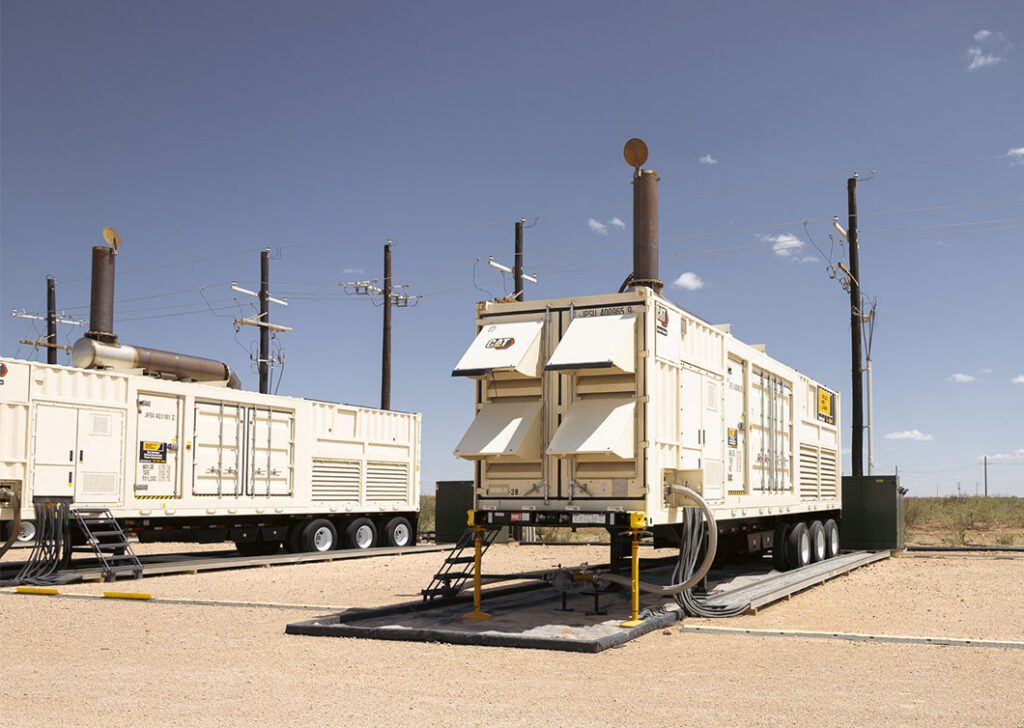
Reciprocating engines are modular, fuel-efficient, and responsive to variable loads.
Advantages
- Fuel Efficiency: Reciprocating generators typically outperform turbines in terms of fuel consumption at smaller scales or lower power loads (especially in open-cycle applications). This means lower operating costs, especially in short-term deployments.
- Modularity & Redundancy: They can be deployed in increments, providing flexibility and redundancy without needing to overbuild.
- Fast Ramp-Up Time: Engines can come online quickly and respond to load changes efficiently.
- Ideal for Projects <50MW: At this scale, reciprocating engines tend to offer better fuel economy and simpler deployment logistics.
Disadvantages
- Higher Maintenance Requirements: Large reciprocating deployments, for example, 100MW projects, would require frequent oil changes and servicing, which can result in higher labor intensity.
- More Mechanical Components: With multiple engines, there are more potential points of failure if not properly maintained.
- Noise & Emissions: Reciprocating systems may produce more localized noise and emissions unless outfitted with proper controls.
Turbine Generators
Gas turbines use high-speed rotating components for power generation and are often found in utility-scale applications or where large, stable baseload power is needed.
Advantages
- Ideal for Projects >80MW: At these higher capacities, turbines begin to outperform recips on both efficiency and cost per megawatt-hour.
- High Power Density: Turbines can deliver large amounts of power from a compact footprint, which is ideal when space is limited.
- Lower Maintenance: Maintenance intervals are typically longer than with recips, especially in prime power or baseload applications.
- Suited for Long-Term Projects: If you’re planning to run baseload power for 3-5 years, turbines may be more practical due to fewer service interruptions.
Considerations
- Higher Spend: Turbines are generally more expensive up front, and redundancy (e.g., N+1 configurations) becomes more costly at scale.
- Lower Fuel Efficiency at Smaller Loads: In open-cycle setups, turbines are typically less fuel-efficient than recips at lower loads (<50MW).
- Water Use: Some turbine models may require water for cooling or emissions control, which can be a constraint in remote or dry areas.
Gas Turbine vs. Reciprocating Engine: Key Factors
At Kodiak, we guide customers through the decision-making process using a mix of engineering analysis and real-world deployment experience. Some of the most important factors to consider when comparing gas turbine vs reciprocating engine include:
| Factor | Reciprocating Engines | Turbines |
| Project Size | Best under 50MW | Best over 80MW |
| Fuel Efficiency | Higher | Lower |
| Maintenance Needs | Frequent | Infrequent |
| Footprint | Larger (many units) | Smaller (fewer units) |
| Response Time | Fast | Moderate |
| Cost | Lower | Higher |
| Duration | Short-term ideal | Long-term ideal |
| Noise/Emissions | Higher | Lower (especially aero-derivatives) |
Projects in the 50–80MW range tend to be more nuanced, requiring deeper analysis of site constraints, economic goals, and customer preferences.
Real-World Flexibility: Kodiak in Action
At Kodiak, we focus on choosing the mobile power solution that makes the most sense for each site from a technical, economic, and operational perspective. In some cases, that means deploying both turbines and engines side by side when a hybrid approach provides the greatest overall value. For example, a project might need engines to provide high-efficiency peak shaving, while a turbine ensures steady baseload delivery.
Whether you’re a utility company, data center, or heavy industrial operation, trust that Kodiak will offer custom-built power systems tailored to your project’s duration, capacity, and commercial goals.
Let’s Talk Power
Need help deciding between turbines or reciprocating engines? Or want to explore a hybrid mobile power solution?
Contact our team to get started. From planning and logistics to installation and operation, our sales representatives and engineers are ready to help you design the right solution.